- Aug 27
What's Driving You?
Subscribe for more
Get our latest conversations & updates
The Invisible Handbrake on Confidence
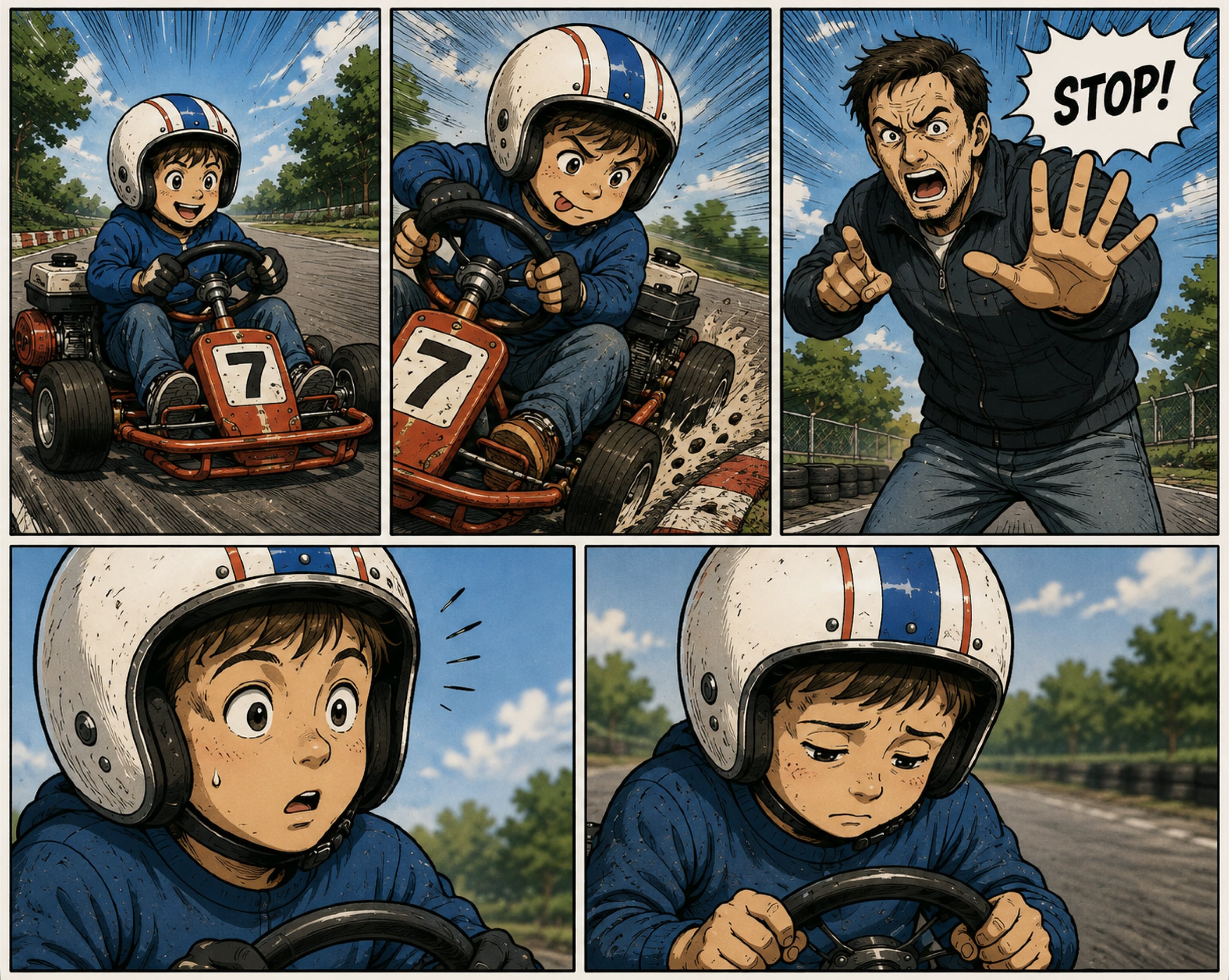
He was eight years old, somewhere in Upstate New York. On a wide unfinished road in a new development, he had the whole street virtually to himself.
And a go-kart.
A proper one.
Petrol engine. No windscreen. Helmet on. Little wooden blocks had been added to the pedals because his legs weren't quite long enough to reach them.
Up the road.
Turn around.
Back down again.
Faster this time.
The engine vibrating through his body. Wind hitting his face. That exhilarating sense of freedom you get as a child when you discover you can actually control something powerful.
And he was getting good at it.
Each run brought a little more confidence.
Then he discovered something.
At the bottom of the road, where sand and grit had accumulated, he could hit the brakes hard enough to make the back of the kart swing around.
Brake.
Slide.
Turn.
Accelerate away.
Brilliant.
So he did it again and again.
Until he looked up and saw his father…
He couldn't hear him over the engine. He didn't need to. The expression said enough.
And in that moment something changed.
Unsure of what to do next, he carried on driving, but more slowly now. He stopped throwing the kart around at the bottom of the road and became more cautious. Instead of wondering what else he and the machine might be able to do, part of his attention had shifted to his father and whether he was still upset.
The fun had gone out of it.
A perfectly reasonable reaction
From the father's perspective, this makes complete sense. Your eight-year-old is throwing a petrol-powered go-kart sideways at the bottom of the road. You intervene. Quite right too.
The interesting part is what happens at the other end of the exchange.
An eight-year-old doesn't process this as: “Dad is concerned about the limitations of this vehicle, the road surface and my current driving ability.”
What an eight-year-old does is feel. He feels:
Dad is unhappy with me.
I've done something wrong.
I've disappointed him.
I shouldn't push quite so far.
Feeling this confident isn't right
And there, in a seemingly unremarkable childhood moment, the mind learns something useful.
Pull back.
Do this and you’re less likely to get shouted at, make a mistake and ultimately disappoint someone important to you.
The problem comes when nobody tells the mind when the rule has expired.
Fast forward forty years
There is no go-kart now. No unfinished street. No father standing at the side of the road.
Instead there is an intelligent, experienced, highly capable adult making decisions in a world built around uncertainty.
This is the story of one of my clients who has permitted me to share here.
When he met me, he was plagued with a sense of perma-nervousness, second-guessing and a feeling that he shouldn't be doing what he was doing. He was trapped in a start - stall - stop loop, frustrated and anxious. He reported that he’d done a lot of ‘self work’ over the years, knew what it was he should be doing and still found that he wasn’t able to ‘get in there and dissolve the knot’.
So we worked together and we dug. One of the key insights that emerged for him was this moment in the go-kart when he was eight years old. A seemingly insignificant incident which turned out to be at the root of one of his key beliefs.
His young mind was taking all of this in at a moment of heightened emotion: the vibration of the car, the shock of his father's strict expression and wild gesticulations, the muffled sound, flushed cheeks and that feeling of being shaken to the core.
Whatever his father intended to communicate, the meaning the eight-year-old took from it was his own. And that meaning mattered.
And as an adult, how did this show up for him? In a pervasive, deeply held set of beliefs that:
I shouldn’t be working on this, I ought to be doing something else, something more important.
What I want to work on isn’t important.
I’m not really allowed to push beyond the boundaries
If I do, I’ll hurt myself or others and disappoint the people who matter to me
Clearly, these were not beliefs that he logically chose. Yet he’d been carrying them for forty years, gradually eroding his self-trust. This had become his modus operandi.
Anything beyond the ‘norm’ required an enormous amount of effort and was met with invisible internal resistance that held him back.
The adult in the room
What looks irrational in the present can make extraordinary sense when you understand where it came from.
The adult says: "I need more confidence."
The mind may have learned: "Confidence is where the trouble starts."
The adult wants to take intelligent risk.
The mind remembers that pushing boundaries once resulted in disapproval.
The adult wonders why he keeps checking.
The mind thinks checking is keeping him safe.
The work we did wasn't about changing what happened on that road forty years ago. It was about changing what he continued to carry forward from it.
At one point I asked him what he would say now to that (forty) eight-year-old sitting in the go-kart. His answer came easily. Push the boundaries. Have fun. See what you can do. Be creative. Explore.
And then came the response from his eight-year-old self:
"Are you sure?"
"Absolutely. Go for it. You’re an adult now."
In many ways, that was the upgrade.
If you’ve made it this far, you might be asking, ‘well, how do you keep the eight-year-old safe?’ The point here is that we’re now working with the adult, 40 years on. Someone who understands risk and has agency now to allow himself to explore in a ‘risk managed’ way.
Sometimes we can see our own patterns. Sometimes we're simply too close to them.
This is the work I do with clients. We identify what's actually driving the behaviour, understand where it came from and decide whether it still has a useful place in the life of the person sitting in front of me today.
I’m very grateful to my client for allowing me to share this story in this month’s newsletter.
As I sign off for this month, I leave you with two questions:
What’s driving you?
And how much of it did you consciously choose?