- Today
The Whipsaw Effect
Subscribe for more
Get our latest conversations & updates
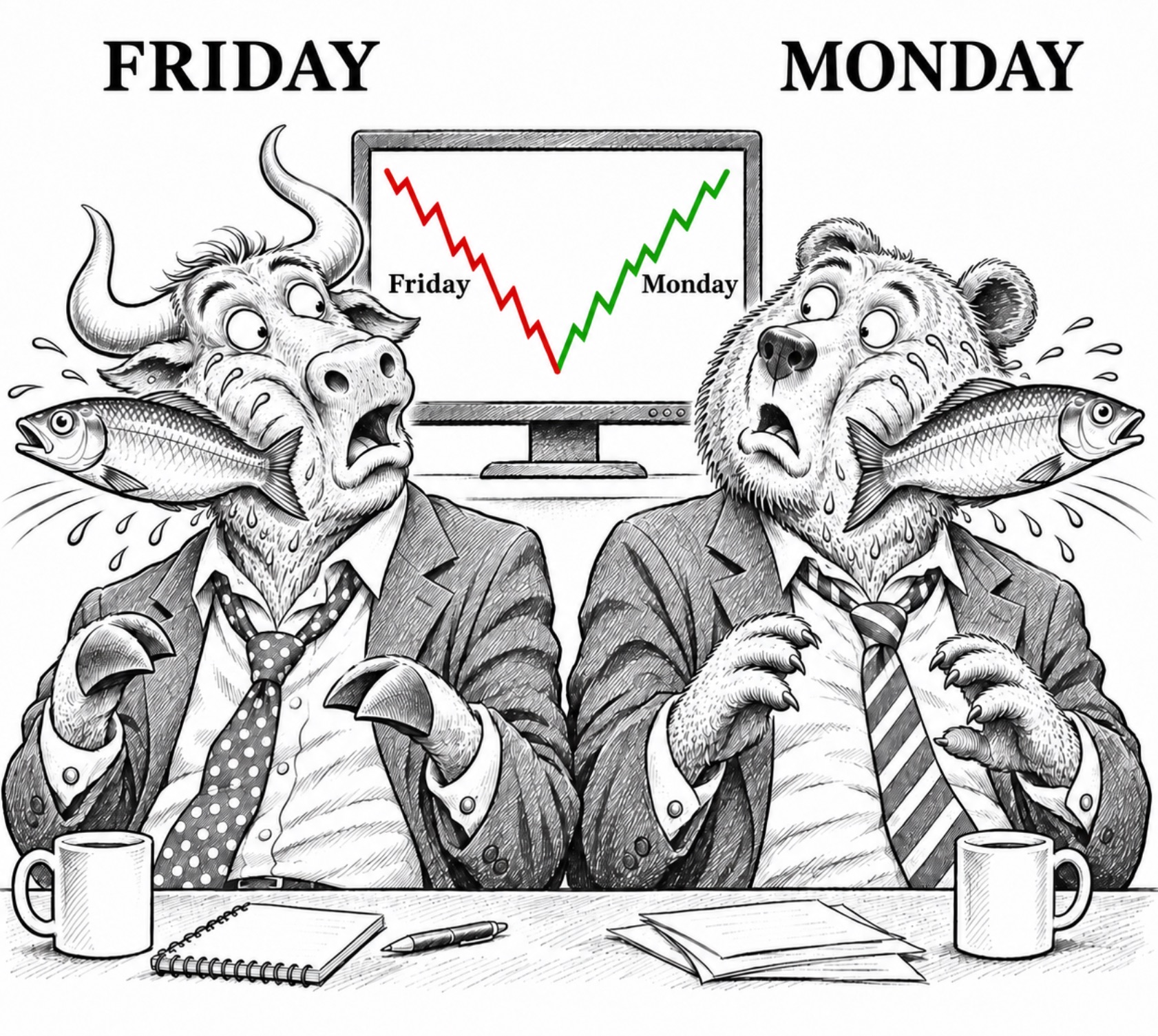
Ever been slapped around the face with a wet kipper?
That metaphorical short, sharp, cold wake-up call that leaves you stunned, reeling and somewhat discombobulated?
The last few trading days may have felt rather like that.
As I type, I can hear Randolph and Mortimer in Trading Places: “Turn those machines back on!”
For anyone who somehow managed to avoid the drama, here’s a précis.
Nvidia shares fell 14% on Friday, 20 November 2026, extending the decline from their all-time high just six weeks earlier to nearly 50%. The sell-off rippled through the technology sector and weighed on the broader market. Come Monday, 23 November, Jensen Huang’s return as CEO helped spark a sharp reversal. Nvidia finished the session up more than 31%.
Quite a change of scenery.
All of this against a backdrop of earnings, Anthropic’s IPO, geopolitical uncertainty and a seemingly inexhaustible supply of headlines.
Whatever your level of experience, there’s plenty to draw you in. The drama. The ranges. The talking heads explaining, with remarkable conviction, what has just happened and what will apparently happen next.
Meanwhile, you have decisions to make.
The experienced trader, investor or fund manager may quite reasonably say, “I followed my process.”
Someone else might say, “I remained disciplined, took the win or loss and left it alone for the rest of the day.” Or, “At least I tried to. I couldn’t quite pull myself away.”
For a newer participant, it may have been another encounter with “You don’t know what you don’t know.” An experience that might, with reflection and time, become useful wisdom.
Those are different experiences. But none tells us the whole story of how the person is doing.
Consider your own experience over the last few weeks.
Perhaps you had conviction about direction, expectations around volatility or longer-term positions to manage.
On shorter timeframes, there were decisions about whether to participate at all, position sizing, timing and execution.
Perhaps the conditions exposed something you hadn’t quite finished preparing for. An unwelcome spotlight on a gap in your process, just when you needed to use it.
Then add the less glamorous operational side.
The brokerage platform having a moment. A sluggish price display. An options chain that won’t load.
The computer creaking while the fan sounds like it’s preparing for take-off.
A telephone call. A meeting. The doorbell. A spouse reminding you about the thing you promised to do.
Meanwhile, prices keep moving.
You might notice your jaw clenching. Your shoulders somewhere near your ears. Your breathing becoming shallow.
Later, you’re tired but can’t settle. Distracted in conversation. Less patient than usual. Taking those supposedly discreet glances at your phone.
You wake during the night and feel the urge to check.
For some, the feeling is agitation or excitement. For others, numbness, exhaustion or a sense of being slightly shell-shocked.
You don’t have to have traded badly to feel any of this.
Perhaps you cut a position, then watched it recover. Held on and wished you hadn’t.
Or you did everything properly. Managed the exposure. Followed your rules. Made money, or contained the losses.
And still finished the week depleted.
Being able to function under pressure doesn’t mean you stop feeling its effects when the pressure eases.
Yet there can be an expectation that, because you’re experienced and handled it well, you should simply be ready to go again.
So you dismiss the strain. Get impatient with yourself. Carry it into the next session, or take it home to people who weren’t involved in any of it.
Where did that expectation come from?
Is it working for you?
Would you even recognise it as an expectation, or has it become so familiar that it simply feels like being professional?
This is part of my work with traders, investors and fund managers.
We look at what keeps you on alert, what you feel responsible for preventing and what stepping away has come to mean to you.
Perhaps staying vigilant feels essential to being competent. It could be that resting feels like dropping your guard. Or, simply that you know you’ve done enough, but don’t quite feel allowed to stop.
Understanding your particular pattern gives us something specific to work with, including how you respond when that familiar pressure returns.
The market will continue to offer uncertainty. The aim is to help you meet it with greater awareness and choice and less strain carrying over into the rest of your life.
Whatever your experience over the last few days, there is a person behind the process. That is You.
Please give yourself some time to get perspective, decompress and notice how you’re actually doing.
If something here feels familiar and you’d like to explore it, I’m here.
Remember - traders, investors and fund managers are people too.
And to those celebrating in the US, Happy Thanksgiving.