- Feb 27
It's All a Con...
Subscribe for more
Get our latest conversations & updates
The confidence game.
What do you think of when you hear that phrase?
It’s a well known phrase which might well lead you to think of the tricks and schemes of a ‘con man or woman’. Someone who promises the world, creates an offer that is attractive to whatever need it is that you require to be met and... depending on how skilled they are and how desperate your need - a ‘deal’ may be struck. From which point, in them you place your trust… and from there events takes their course.
In this context, the idea of the prefix ‘con’ is a ‘lie’, an untruth… a story. Which leads me to the question…
Have we considered for a moment that we might actually be complicit in conning ourselves?
Consider those times we may have knowingly overridden a certain feeling that something is off.
Or simply run an automatic unconscious expectation of an outcome that shows itself in statements such as ‘just my luck’.
Let's take a closer look at the meaning of the word confidence
Prefix: con (derived from Latin com) means ‘together’, ‘with’, or ‘completely’.
Root: fid (from Latin) fidere or fides
Suffix: ence (derived from Latin -entia)
Together with or completely
Trust faith or belief
The state of having full trust
So it seems, despite the true meaning of the word confidence… embedded in the common parlance of 'con', is the belief of a lie.
This leads me to ask what are those lies that we are telling ourselves? What are our truths? How do they impact on our confidence levels?
Let's look a little more closely at the idea of confidence.
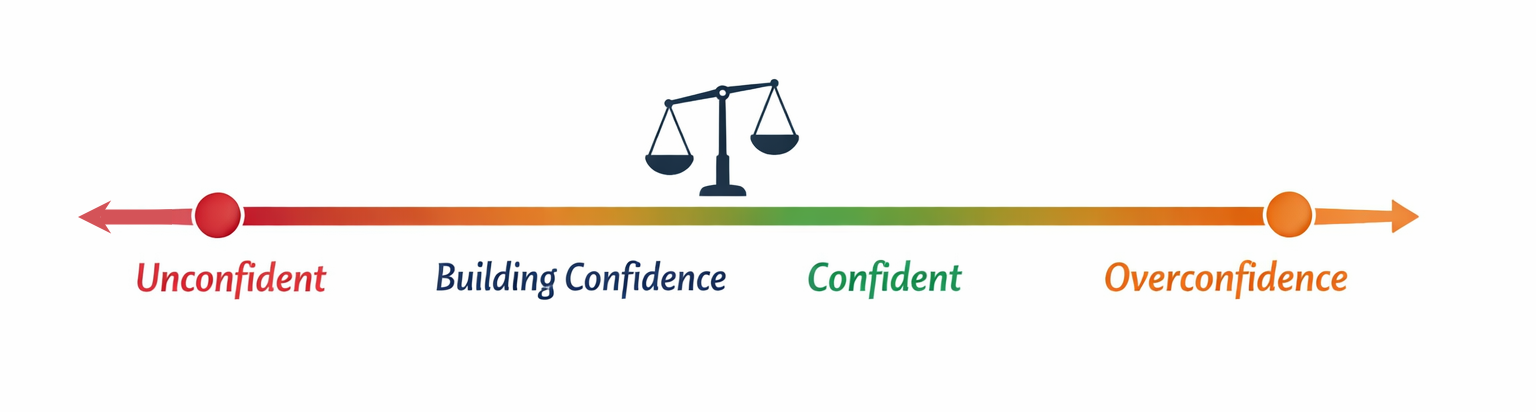
One may choose to see it almost like a spectrum with markers that take a person from: unconfident to building confidence to being confident to becoming overconfident.
Any adverse knock having the effect of sliding one down the scale. Should those knocks be severe or long lasting enough (think accumulation of slights causing a pernicious constant underlying hum of uncertainty) we are humbled and start again at the beginning with a beginner's mind. Any fortuitous lift of course, enforcing and reinforcing a sense of certainty. Stasis is found at the intersection of building confidence and being confident.
How is confidence built?
This may well be familiar. Bear with me.
Confidence comes from: building knowledge (education), skill (practiced, repeated, reviewed, examined and improved upon) over time which leads to experience (which includes the review and monitoring process too). From these activities we get reference data that underpins the rationale and the ultimate ‘go - no go’ decision along with an opportunity to review, refine, adapt. Which over time builds trust in both the process, our skill and ourselves.
That trust element also starts to show itself with a certain feeling in the body. Be it in the gut, the neck and throat, the chest or even in the palms of one's hands. That feeling of stillness and calm when things are as they should be or when things are not quite right: a vibration, palpitation, constriction. All of these giving data points that many of us do not track or choose to let slide. The more subtle the sensation, the more we normalise / override.
In our industry, confidence plays a pretty integral part in how we perform and show up no matter what role we play. We require confidence to be able to communicate, to pitch, to explain, to hold steady in the face of data that we’d rather not be associated with, to initiate an investment, to hold it, to exit and decide around the sizing thereof.
So where are you on that scale of confidence? How do you arrive at a decision?
Consider one extreme: The character ‘Dollar’ Bill Stearn, from Billions and the question and response:
‘How confident are you?’… ‘I am not unconfident’.
Leaning clearly on the less savoury flavour of ‘con’ (insider trading) sprinkled with arrogance, bravado and every other stereotype that comes with fund managers as depicted by film and tv.
And compare and contrast the approach of Annie Duke (pro poker player and author). A proponent of:
Probabilistic thinking
Understanding base rates
Separating decision quality from outcomes
Accepting that the idea of ‘certainty’ is dangerous (if we enter the realm of blinkered thinking).
Logical reasoning, scientific approach to reasoning and decision making.
If you are reading this article, I’d wager that you lean more towards Annie Duke’s method than the other, though I admit, we’re not infallible to the risk of overconfidence from time to time. (It shows up particularly the more experienced one becomes and the more ones identity is attached to performance track record).
Through my work, I’ve observed that even with the adoption of this scientific method… There's still a point at which confidence breaks down.
Put another way… Knowing how to think is not the same as being able to think when one is under pressure.
In the moments of extreme hesitation and fear the mind will go to that immediate worst case scenario.
For those of you that have found moments of confidence crisis, you will understand it is one thing to appreciate this from a book learning standpoint. It’s quite another to experience it in the moment… It’s just one of those lived truths...
Pressure is essentially synthesised as a threat. As such - under pressure, cognition degrades. The ability to access clear rational thinking is hijacked and we’re held hostage to our automatic embedded thoughts and unconscious functions.
Here’s an example:
Thought: “This is going to fail”
The mind automatically goes into defence mode.
Adrenaline and cortisol spike
The body is preparing for fight / flight / fawn
Attention narrows
Worst case scenario vigilance activated.
Body cues reveal signals externally: breathing changes, palms sweat, jaw tightens..
-
Words uttered (either in the mind / expressed)
Typical. Just my luck. Of course this was going to happen to me.
I should have known.
I’m going to get f*cked. They're going to f*ck me over.
This doesn’t smell right.
-
Words uttered externally - logically self soothing
Maybe this time it will be different...
Deep gut reaction to those words : I don’t trust this - it's just wishful thinking
The body now in fight mode says NO.
All of this … triggered in a split second - by an embedded thought that was triggered and activated in you.
For those of you interested in delving further into how the body reacts to thoughts / stress in our industry have a look at The Hour Between Dog and Wolf by John Coates, I highly recommend it.
So… my invitation to you:
Get curious about what thoughts (and beliefs) are embedded as a ‘norm’ in your mind. Thoughts that impinge on your own level of confidence. Here are a few questions to consider:
The last time you felt fear, what did you say?
What did you expect would happen?
What did your body do?
Become conscious...
Prefix (con): derived from Latin, meaning ‘with’, ‘together’, or ‘jointly’
Root (sci-): derived from scrie (‘to know’)
-
Suffix (-ous): An adjective-forming suffix meaning, ‘having, full of, or ‘relating to’.
Together: being awake and aware.
In the pursuit of confidence, my invitation to you dear reader is to become conscious of your silent operating system.
Perhaps the real confidence game is not played in the market at all.
Perhaps it is played internally.
In the split second between stimulus and response.
In the story you default to when uncertainty rises.
Pay attention to your most habitual thoughts. Get curious about the cause and effect of what you think, say and do. Create a new default.